


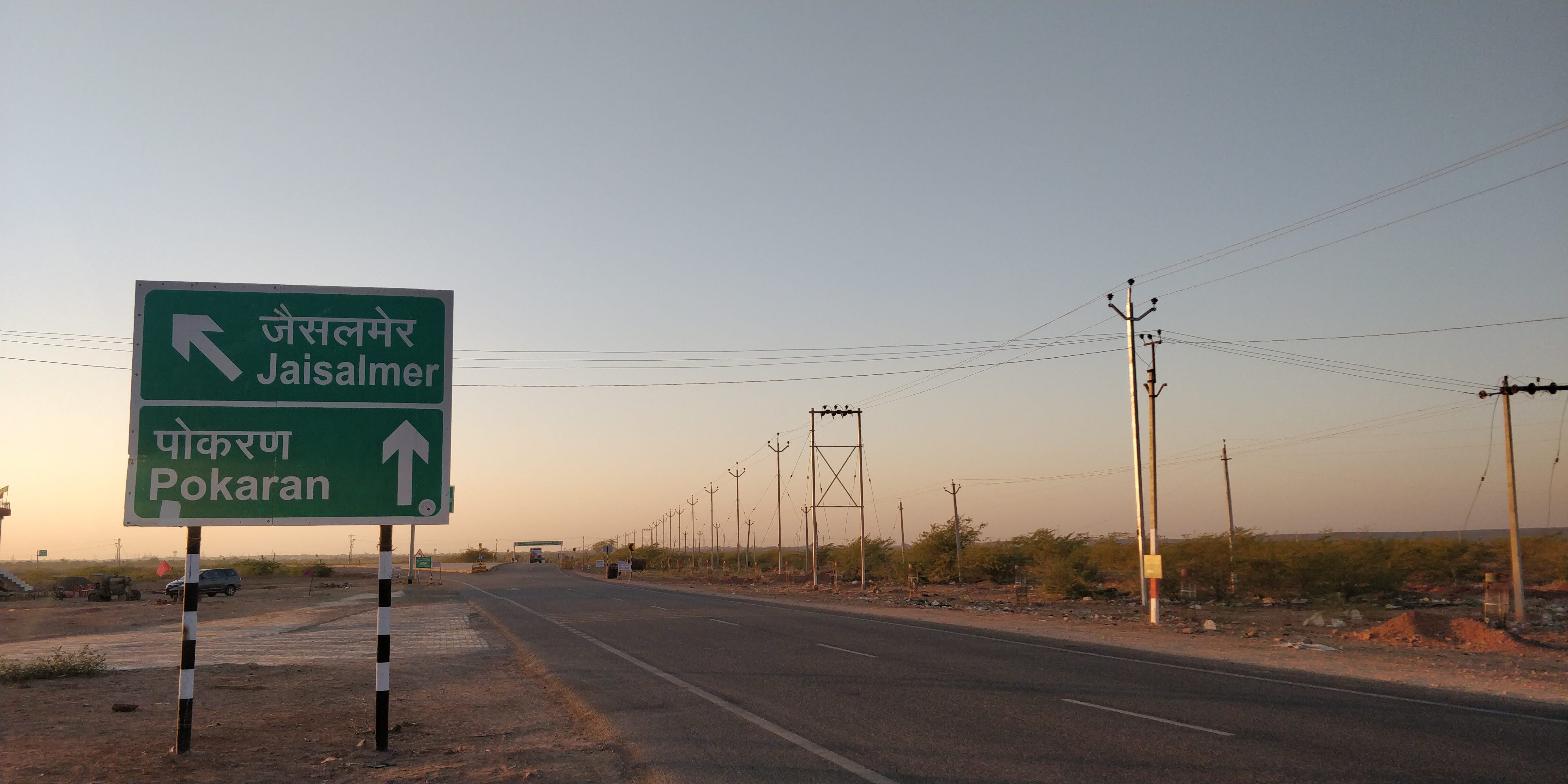
I was not aware of what I would find when I first stepped out of the car in Pokhran. It was an arid desert, very different from the geography that I’m used to, and yet so familiar.
It is hard to quantify the view of a 5 p.m. sunset, but it goes something like this: The sun sitting lightly on the lip of the horizon, asking—no—demanding from my soul the very question of existence. I did not know what to say. I felt helpless. But it was a beautiful scene. I was soon going to enter the city of Jaisalmer.
It was 2018.
Right around Christmas holidays, we’d picked our brand-new Suzuki Ignis for a trip to the northwestern extremity of the state of Rajasthan, in India. So far, and we’re talking nearly 400 kilometers (or 250 miles) far, the scenery outside was, well, different.
Not in a bad way. It’s just that the people of the hills usually have difficulty orienting themselves within the plains, especially when said plains are largely made of arid flats and dunes stretching farther than the eye can see. But once you roll into the city aptly titled “Golden,” you start getting your bearings. Or so it seems.
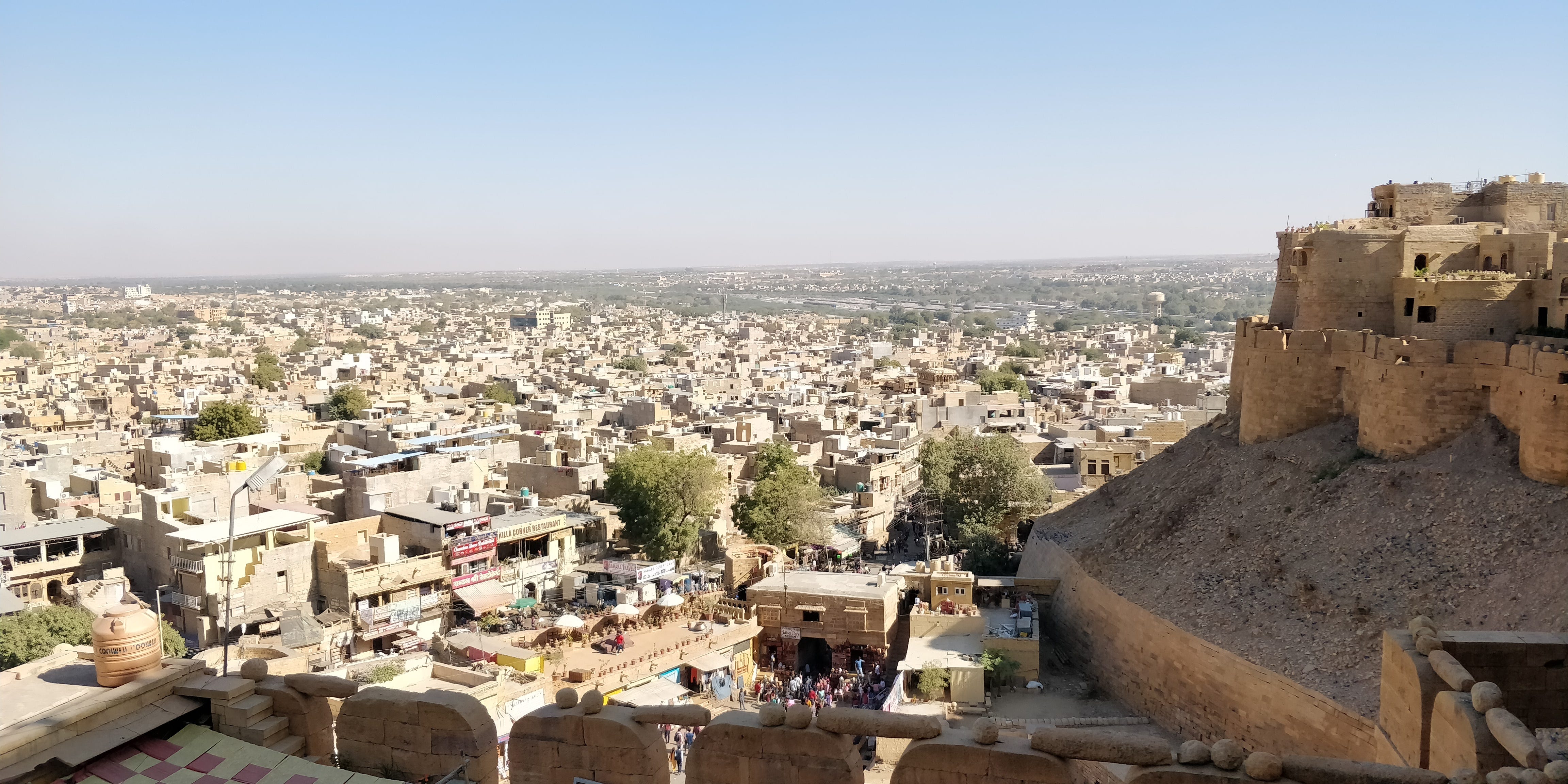
By and large, Jaisalmer felt like any other city or town within the state of Rajasthan. A motley mix of modern, traditional, and functional buildings, people loitering around or doing their busy selves, cows on the streets, vendors selling hot snacks, and a big sea of tourists hitching rides or asking for directions. What really stood differently in this makeup—although not too differently—was the sandstone fort perched imposingly over a stony slab of a hill.
Funny thing, sandstone. Quite an oxymoron when you squint your eyes at it. How can sand be stone? But that’s geology for you. And the stone does lend a certain charisma to its creations. Stacked and shaped to sustain the royal household, it commands a different reverence. Monumental, yes, still somewhat dusty.
Now, that’s a word that really sums up what Jaisalmer feels like: dusty. Perhaps it’s the constructions of sandstone that give this city its distinct imprint, or perhaps (and more likely) it is the proximity to the Thar Desert.
Keeping the adjectives aside, it was the sunny afternoon of Christmas Eve that we found ourselves at the foot of the Jaisalmer fort, looking as tiny as we could in front of the gigantic gates. I wonder how mighty the kings of the bygone Rajasthan would have felt, looking down from the parapets, observing the city’s antsy occupants crawling about.
And then there’s the climb. A weird mix of flagstones and other stone blocks that my half-assed architectural mind cannot guess takes you up a slow walk towards the entrance proper of the fort. Peppered along the winding path were colourful characters ready to shove their cultural crafts, headgear, leather products, and an assortment of photographs into the tired Indian and overzealous foreign tourists.
The fort, in itself, felt lacklustre. I’ve seen many of Rajasthan’s famous keeps, castles, and fortresses, but none so commonly public as Jaisalmer’s.
There was no traditional compound-like feel to it, no courtyard for your non-existent curling moustaches. If anything, it felt like a busy street of an old city; not a relic of the past but an eroded route still in use. So, we did what everyone always does—a photo here, a photo there, a glass of lemonade, another of spiced buttermilk, a climb to the battlements, a dive into inner chambers (no guano this time, unlike the Amer fort). About an hour and a half later, we found ourselves in a restaurant outside the fort, tired and bested by the December Sun.
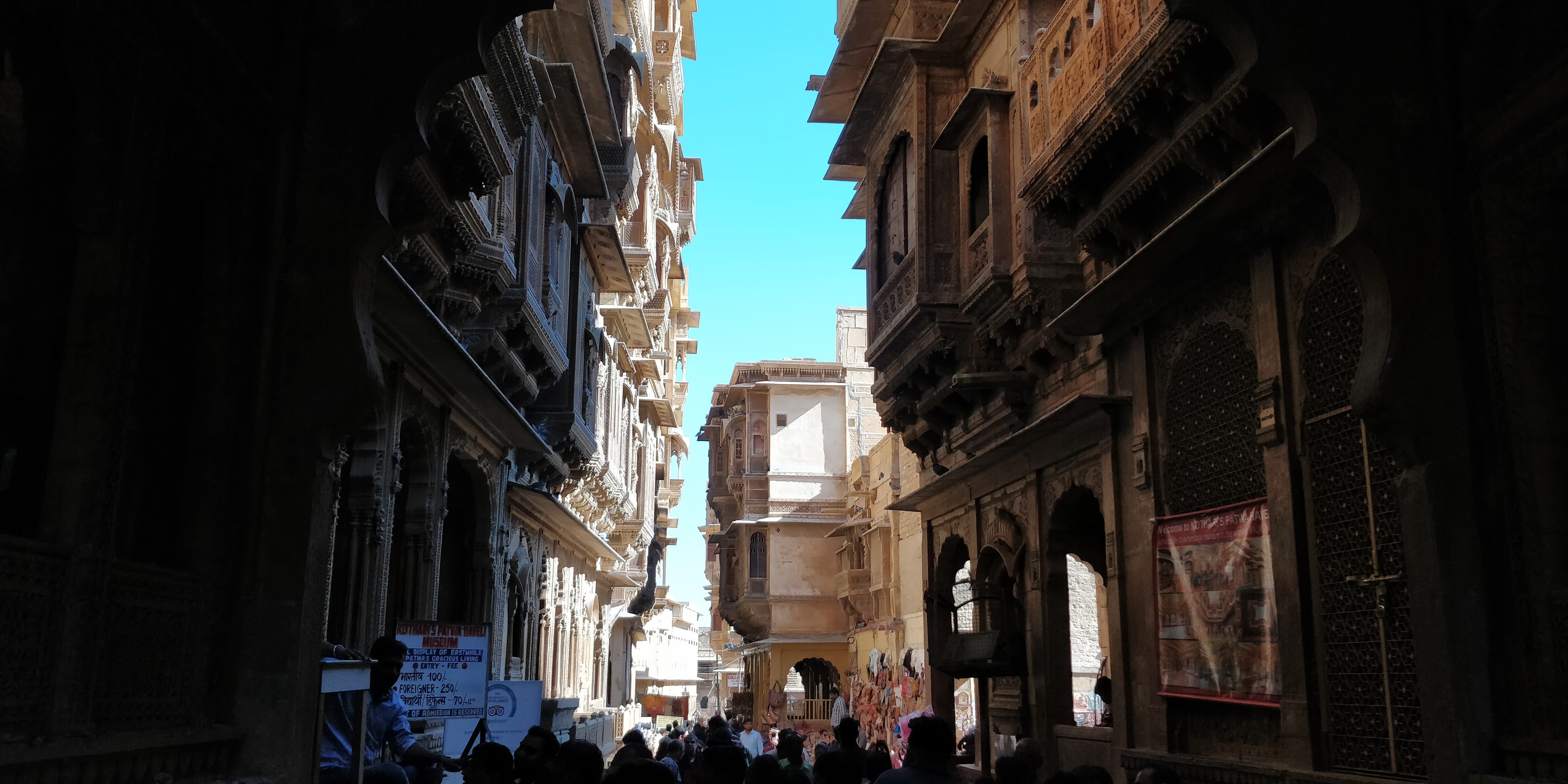
Now, we could have called it a day, but we had two more destinations planned in our itinerary—Patwon ki Haveli and the magnificent Sam dunes. The former was a mansion of a now-deceased family of traders, and our first curiosity pick. Architecturally, it felt grander, and characteristically, it felt richer—more so than the fort. In a compact space on a busy street, this trader family had built itself a luxurious living that even the rich housewives of Jaisalmer’s fort couldn’t. All out of sandstone, you see.
After an unimpressive view from the terrace of this mansion, we climbed down to take on the next leg of our journey. The new family hatchback was glad to see us coming back to it, I assume, glinting proudly in hues of azure blue and bands of blinding sunlight. On we took it to the stretch of a road I had never imagined I’d drive on.
The famous sand dunes are outside the city, obviously. (Kudos to whoever thought they started the moment you enter Jaisalmer, or Rajasthan; we owe it to you for a barren portrayal of Rajasthan.) Along the stretch of the road, we encountered many Jeeps sprinting across dried mudflats, aiming to lift a tourist hanging from a paraglider—all in hopes of entertaining the customer for their 150 bucks. Tough life. Before the Sun started its sink into the horizon, we arrived at a miniature city of tents opening onto the carpet of the desert.
“400 rupaye!”
(400 Rupees!)
“Kyun? Itna mehenga?”
(Why so costly?)
“Haan ji, madam. Teen daure hain, Jeep se jayenge.”
(Yes. There are three dunes, and we’ll go through the Jeep.)
We—or rather my mom—didn’t haggle much. A jeep “safari” through the dunes for 400 bucks? We were in before the tent guys could say “aur tent ka hazaar rupiya” (And a thousand rupees for the tents).
I’ll be very frank here. The word “safari” was doing the semantic weightlifting here. I, for one, had the image of driving around the sand dunes, or sand flats, maybe seeing the occasional bunch of cacti. Man, did I learn the definition of “wrong.”
In what I can describe as sand surfing, we clung tight to the bars within the 4x4 as our driver lurched through and jumped from one dune to the next, occasionally stopping to rev the engine sufficiently to brave the next climb. Sand was everywhere (sorry, Anakin), and it probably clogged my synapses because I was enjoying this thrill. We went “surfing” for nearly fifteen minutes, I assume, before arriving at the third cluster of the moving dunes. This was our stop.
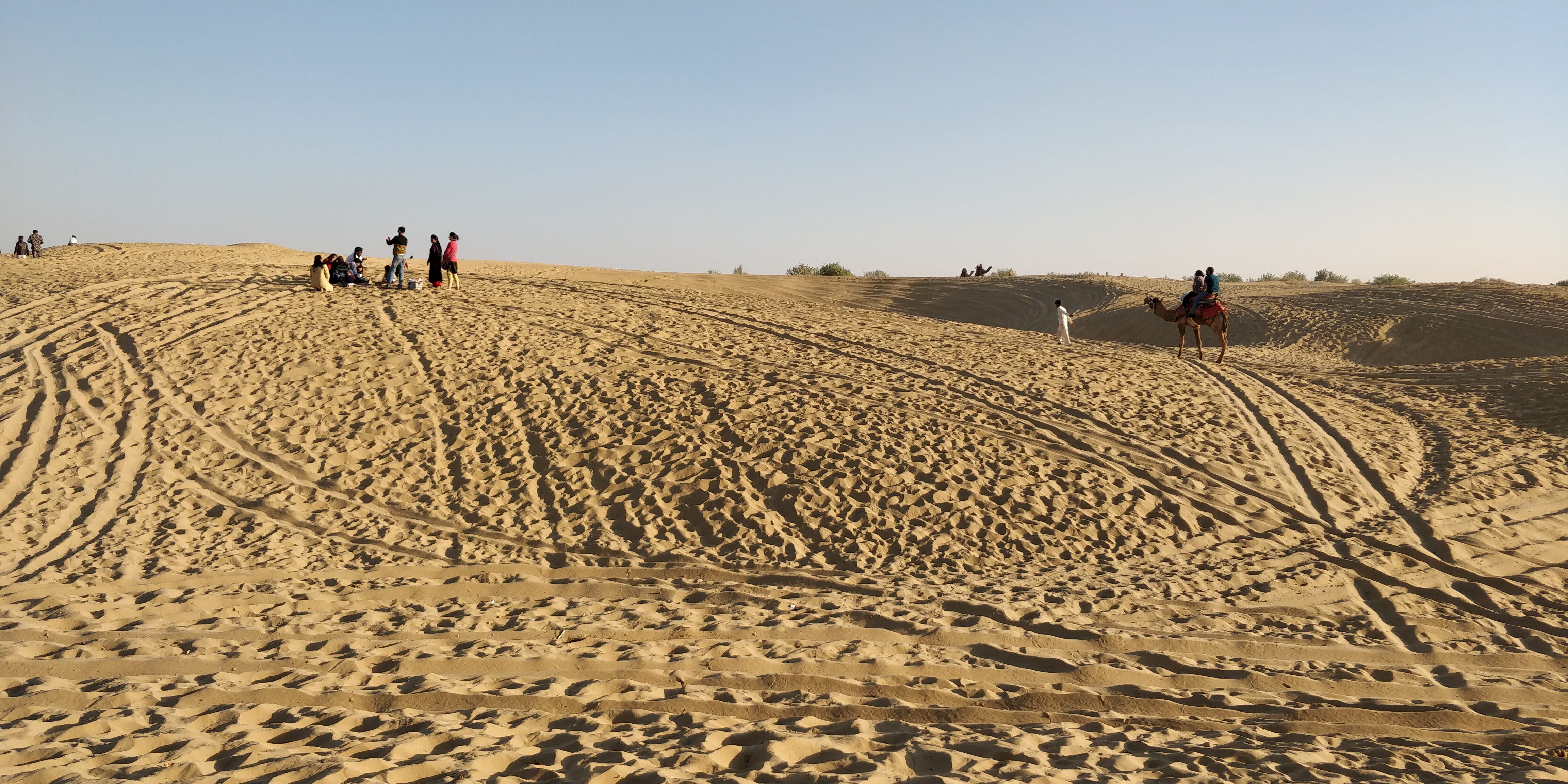
Again, I’ll draw some parallels here because, for us rocky-terrain dwellers, a solid footing is an oft-overlooked sensation. Step into sand (not your kindergarten sandpit, no) and you’ll feel that years-long confidence of walking eroding away from within. Each step is a precarious test of leg muscles, centre of mass, and heel-to-toe assisted body articulation to find a firm footing.
Dusk was approaching, but it was tucked behind the blanket of a twilight yet to come. I had definitely lost my bearings. This was not my natural habitat. The desert, a tourist spot for the colourful travellers, wanted you to feel comfortable. Pierce the absent veil of a mirage, and you’d find it unforgiving—beyond the cacophonous laughter of tourist selfie sticks, old-fashioned whisky clinks, and show-offs of personal 4x4s surfing about—the desert was the antithesis of Rajasthan: Inhospitable all around.
But we, being tourists, enjoyed ourselves a lovely time in this human-selected spot between the dunes, had a camel ride (the jockey playfully named our quadruped companion Jethalal from a popular Indian sitcom), and saw Kalbeliyas belly-dancing to get a taste of money or whisky, whichever was offered first. Yeah, it was turning out to be a joyful evening, for we did not see the twilight roll in.
As the Sun came to kiss the horizon goodbye, I remembered Pokhran from the night before. The barren sight of India’s first clandestine nuclear test, visited by a bipedal with more atoms than needed, just to see the sun and take its pictures. I thought it was rather poetic to see the core of our lives representing the nuclear fission reaction practiced on this soil. Well, and let me tell you, dear reader, the sunset at the edge of (or so we felt) civilization in a desert felt spiritual and destructive.
A passage from the Bhagavat Gita, made famous by J. Robert Oppenheimer’s recitation, snagged at the moral terminator within my mind. As I continued to observe the Sun’s slow descent into the sea of darkness, over the edge of Thar, the lines echoed wilfully within my mind’s desert:
If the radiance of a thousand suns were to burst at once into the sky, that would be like the splendour of the Mighty One . . .
I am become Death, the Shatterer of Worlds.
I certainly hadn’t become Death. But surrounded by the hostile desert, uninviting, woeful, unforgiving, and naked beneath the Sun’s fading gaze, I felt alone. I felt like I was sculpted from sandstone, etched with the experience of twenty-odd years. And if the curtains of the night were to fall, the dunes would swallow me whole. That wealth of life, eroded to atoms. The courts of ego, ground to zero. When you think about it, there is no “I” in the desert.
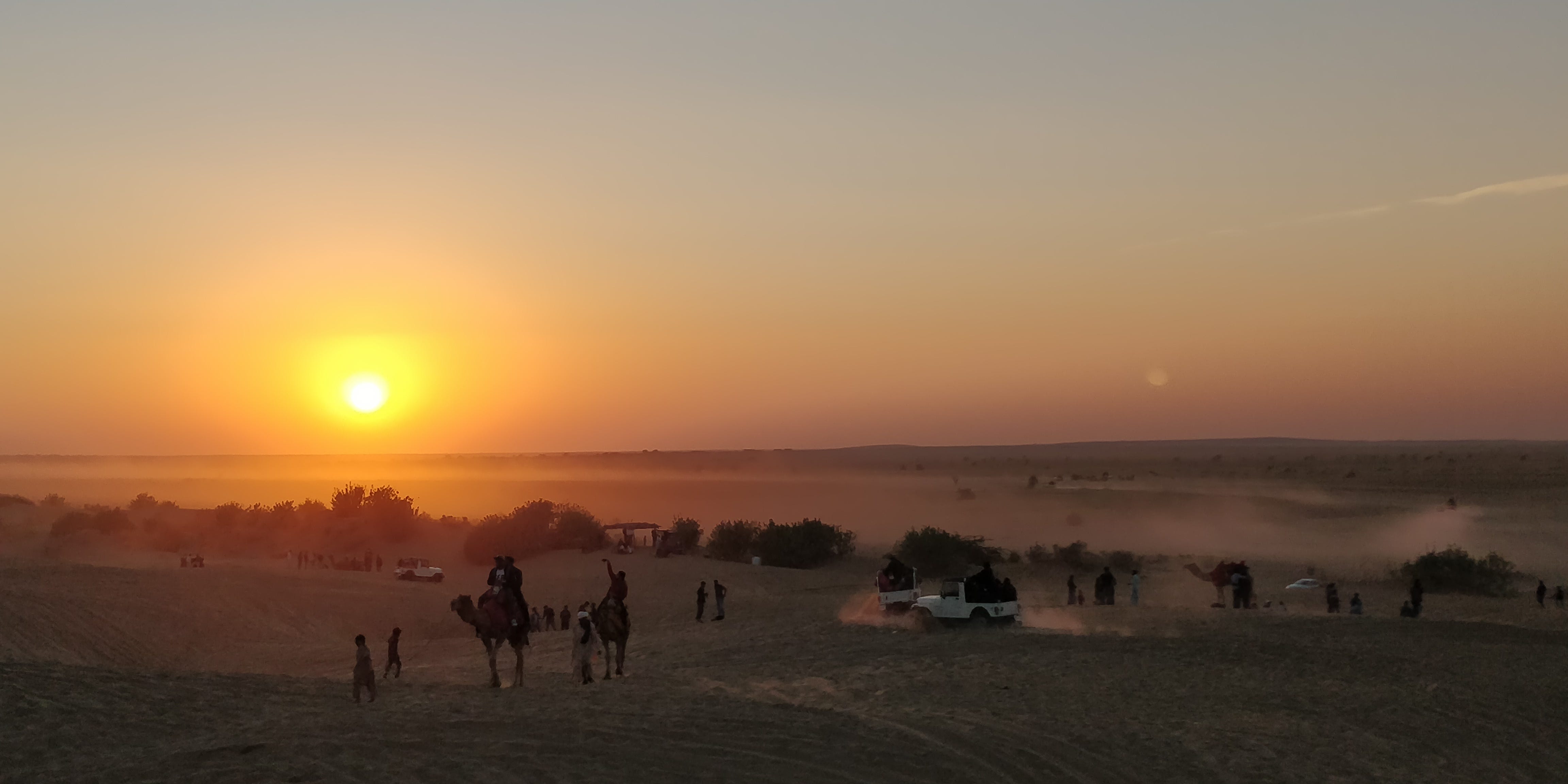
“Sir ji, time ho gaya hai lautne ka,” alerted our driver (Sir, it’s time to leave).
His upbeat lilt had successfully pulled me back into the reality of departure. As we walked back to a smoother shortcut to concrete plains, I think I left—no, lost—something behind.
That part of me never returned. Perhaps it haunts a shade downwind the swell of a dune, latched on to the idea of Jaisalmer’s desert attaché of inhospitality. Or perhaps, it’s only my overactive imagination. But I won’t discount it.
Some days, when I close my eyes, I find myself back on the crest of that dune.
The Sun sinks, and so does my sleep.

wow 💯
Waahh! Kya baat kahi h end me :')