

The Act of Playing God
A mere mortal’s diatribe on immoral mortals who check the boxes of terrorism for promised immortality.

Guillermo del Toro’s Frankenstein—which my wife and I enjoyed between our daughter’s naps—has brought back the age-old debate. In his Milton-esque adaptation of fathers, sons, and Promethean, life-giving promiscuity, you find the consequences of playing God (or gods, if not the Abrahamic Capital G) blasting square into your knees as if a 12-gauge buckshot. It stays faithful to Mary Shelley’s masterpiece, yet brings out a nuanced tightrope ballet between life and death.
As this evergreen story goes, the creature (Frankenstein’s monster, played by a brilliant Jacob Elordi) finds himself in a trap of life, unable to live a meaningful life and unable to die with a meaningful death. His chase for the metaphorical period to punctuate what never was his never comes. Yet his creator (the ever-charismatic Oscar Isaac) fails his purpose. His self-appropriated mantle of Prometheus crumbles to ashes when he fails to be a father that his father never was.
And so, in the third act, both father and son try to play God with unsuccessful results. The sun might have shone for the creature, but he is forever left alone. Is that the price of freedom anyone who lives is ever willing to pay?
Oh, now Jagruit, you might be saying (if you’re reading this, of course; otherwise, why would you?), why do you have to bring existential questions of philosophy in what looks like a breakdown of a movie?
To that, I’ll reply most humbly, making it clear that this is in no way or form a discourse on the actions of Victor Frankenstein or his creation. Rather, like John Milton’s epic, it is about the Paradise that was lost, the Paradise that was chased, and the Paradise that no one found, even in death, or when the sun sets.
In the recent car blast near the Red Fort that shook India, the people, the victims, and the perpetrators witnessed this Miltonian act of equating oneself with God . . . and the consequences of such an action.
But why do people—terrorists included—want to play God? Will they ever find the promised land?
I have no clue. I am no fundamentalist. But I have dabbled in what I’d call the act of playing God. And I’m going to use that to deconstruct an argument into the terrorist psyche.
Diomedes in a Digital Sandbox
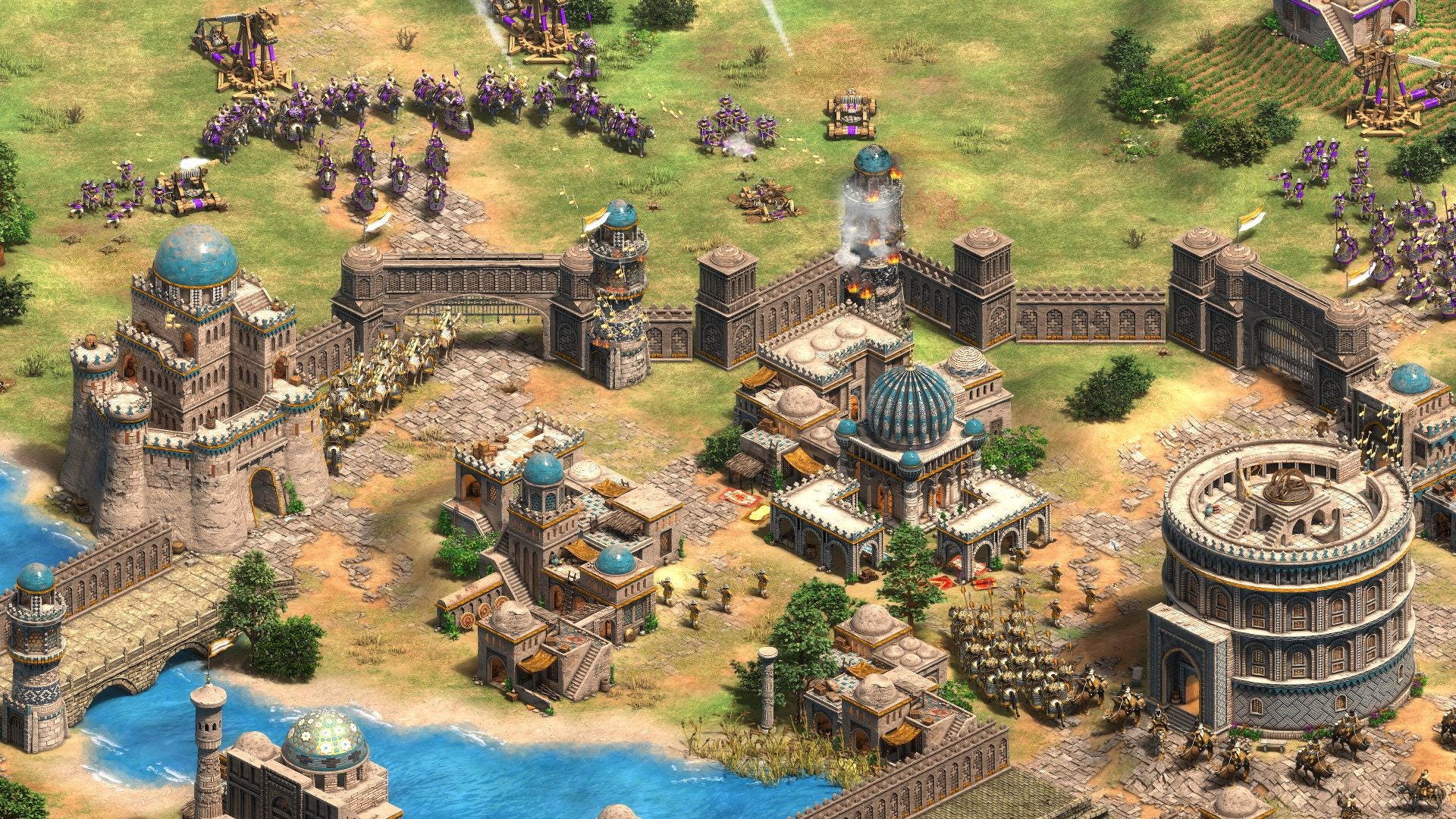
Ensemble Studio’s turn-of-the-millennia, real-time strategy hit, Age of Empires II, was my introduction to a whole different category of video games. For all my cognitive capabilities, however, I cannot recall who gave me a copy. Nevertheless, I first found my hands on (and in) the game almost six years later.
For someone raised on the traditional mills of third-person action-adventure and side-scrolling games, AoE II (as I’ll refer to the game hereafter) was a different breed of entertainment. You create, you wait, you explore, you manage. It wasn’t exactly the thrill I’d chase when I booted my dusty old desktop. There was too much to work through and too much to act upon. Even then, the results wouldn’t be in your favour.
And yet, there was a charm to it. I enjoyed erecting buildings and giving my tribe sustenance. I was gripped by short skirmishes between my strongest cavalry and infantrymen and the CPU-controlled enemies. And in between bouts of harvesting, scouting the map, and training military, I found a rhythm of calm and a potential for achievement.
In the age of my Age of Empires experience, I drifted to other titles of the same genre: Age of Mythology, Star Wars Empire at War, Age of Empires III. And one Roller Coaster Tycoon 2, an offshoot park management game gifted by my cousin which was a one-eighty from RTS games yet built from the same bones. Now, I know it’s not too deep a list (it’s atrociously pale in comparison to what hardcore RTS gamers would play), but it’s vivid enough to keep the games alive in my memory. None, however, lived in my memory as fiercely as AoE II.
Years later, with (relatively) more wisdom under my belt, I think it’s easier to reflect on the winning formula that got me hooked, albeit briefly, to these games.
Age of Empires, and its siblings in the genre, give you a tighter experience in terms of what I like to call fiddly sandboxing. You, the player, are the commander of everything that’s happening on your screen. Unlike, say, Sonic the Hedgehog, where you only control the actions of Sega’s blue mascot, or Doom, where you’re one with the first-person POV yet still only bound to controlling the Doomguy, RTS games allow you to command and conquer any and all within your screenspace.
You can command your villagers to do your bidding (although in a limited framework of actions, but still), and the end result could very well spell your downfall. But that never stopped you from using your mouse to pluck at the digital lives of your tribe. Hell, in Roller Coaster Tycoon 2, when the crowd of guests would get angry due to fewer janitors in the park or negatively rate my rides, I’d pluck them up and throw them into any water bodies around. Let them drown with their opinions.
You see where I’m getting at? These games let me play God. I might not have been the maker, but I was the supreme being outside the digital bits and bytes, shaping what happened to them through my actions.
For the Creator Outside Creation
In the entire existence of humankind, two things have been concrete to our DNA: displacement (or migration) and myth-building (or religion). Our feet took us across the globe, covering great distances. Every fork in the journey was a new branch, not only in genealogy or geography but also in cosmology and eschatology. The real treasures of diversity were the Gods we earmarked for creation myths along the way. Life and death were with nature. In a cycle.
And then we settled, giving birth to new legends, to stories that married the Gods of heavens with mortals of mires, with glories of the stars or rests in the Elysian fields. Civilisations came together, city-states were formed, the Silk Route and seafaring trade commenced, military occupations against rivals consumed. And in all this, along with even more migration, the people subsumed.
That was so until the polytheistic open-minded faiths narrowed into cult-like followings of monotheism.
Then, subsuming into a society did not allow for diversity. There was only one Supreme being, said one, then another, and finally a third. They fought. They massacred. They proclaimed the name of the holy and painted his shrines in blood. Their cosmology demanded subjugation. Their eschatology had a period to end all periods. The after that came was a promise unseen, but a promise believed.
I do believe you can see where this is headed. Still very much like the games I discussed, don’t you think?
There is no fundamental difference between the Crusades of yore and Christian fundamentalism of today, prevalent in the U.S. No chasm of separation between the occupation of Palestine by Zionist forces in 1948 or the modern Israel-Palestine conflict. No foundational schism between the jihad of the sword in the medieval world to push against the opponents of Islam and the jihad of terror nexuses against the sensibilities of the new world.
Every instance of war and terror is an instance of acting for a God that sits outside reality. A reality where human interactions beget human living. In the name of the holy land, the promised land, the promised afterlife. The promise will be delivered after all the teachings of humanity have been eradicated. So what if Christians die in crusades, Jews die in Zionist occupations, or Muslims die in acts of jihad?
It is all for the Creator, the capital C of monotheistic sisters in a boardroom of superiority complex, their manifestos stacked neatly beside their holy books as annexures of holy word. All that’s missing is a computer simulation to play out their fantasies before they declare war.
Frankenstein’s obsession with conquering death led to his demise. My fascination with digital dogma in video games led me to commit crimes that, if outside the world of video games, would hang me under the Geneva Conventions.
But the terror attacks?
On the evening of 10th November, 2025, a car explosion on a busy artery of Delhi’s roads near the Red Fort took thirteen lives and left several injured. A shadow of terror when compared to the one on Taj Mahal Palace in 2008, yet one that left a permanent scar.
Those who passed away were just people. People running their shops. People returning home. People with dreams, expectations, families, and lives full of meaning. The car that exploded, itself a suicide attack, was but a period to end all their periods of meaning.
In a very Shelley-esque development, three of the perpetrators were doctors. Life givers became life absolvers. They were Victor Frankensteins, their blast an obsession with death. They played God, in whose image they were made. A God who is as controlling, as demanding, and as vengeful as a mouse-trigger-happy thirteen-year-old.
Death for a promise, even if their own had to die.
Death for a paradise lost. Paid for by innocents.
Deaths for a paradise that will never be.
That is the cost of playing God.
